

Sustainability does not always need more data, regulation or complicated language. Sometimes, it just needs an icon we already understand.
A crocodile is not usually an animal we associate with protection.
It is powerful. Aggressive. Ancient. Something to be feared rather than saved.
For Lacoste, however, the crocodile has meant something slightly different for more than a century.
René Lacoste was nicknamed “the Crocodile” by American journalists in the 1920s, a reference to both a story involving a crocodile-skin suitcase and his tenacity on the tennis court. The nickname eventually became an embroidered crocodile on his clothing and, later, one of the most recognisable logos in fashion.
For decades, that small green crocodile represented determination, sport and French elegance.
Then, in 2018, Lacoste did something remarkable.
It removed the crocodile.
The moment an icon gave up its place
During Paris Fashion Week, Lacoste partnered with the International Union for Conservation of Nature’s Save Our Species programme.
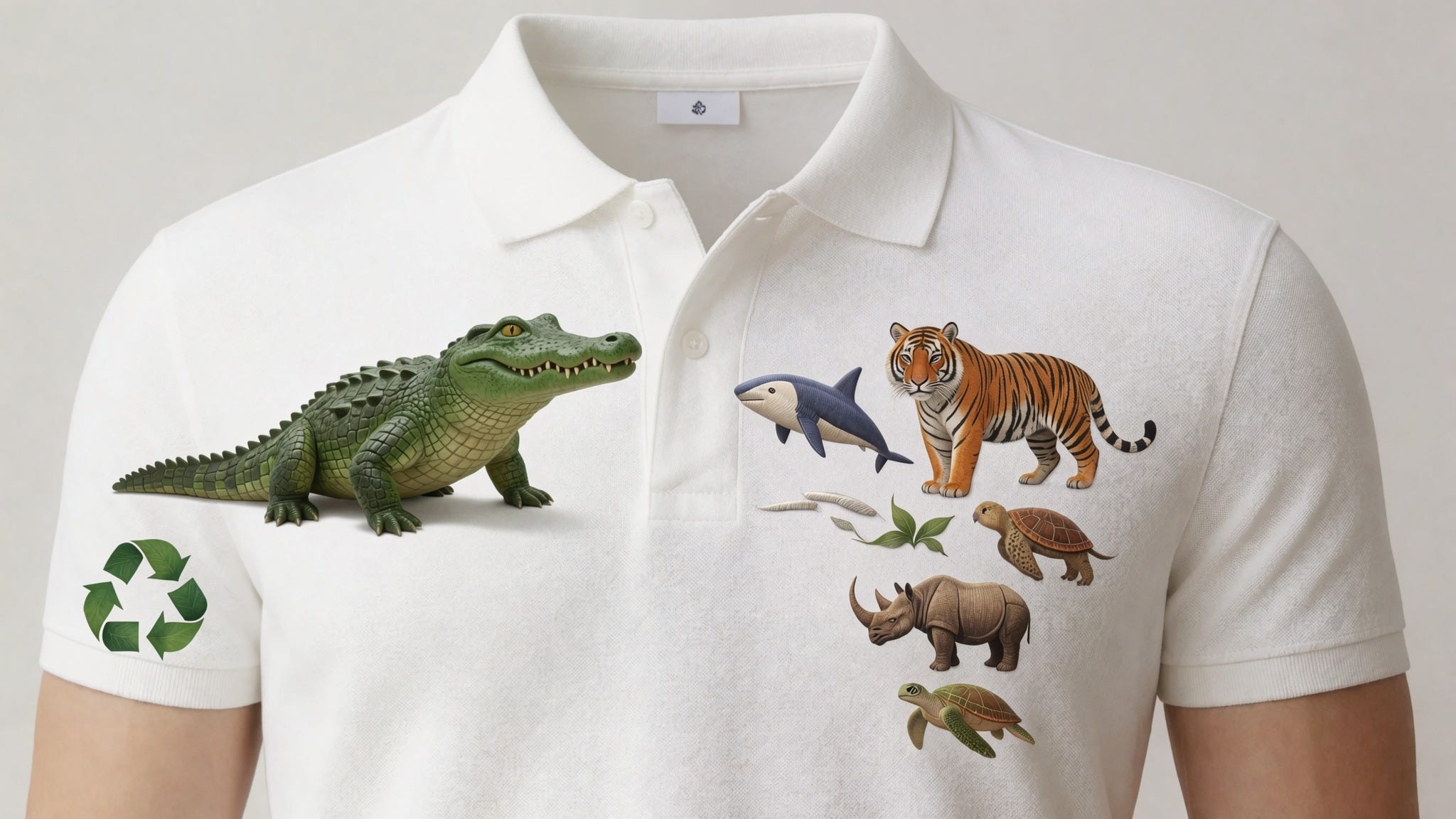
For a limited collection of polo shirts, the famous crocodile disappeared from its usual position on the chest.
In its place appeared ten critically endangered species.
The number of shirts produced for each animal corresponded to the estimated number of individuals remaining in the wild. If only a few hundred animals remained, only a few hundred shirts carrying that species were produced. The collection sold out within 24 hours.
It was a remarkably simple idea.
No giant sustainability report.
No complicated infographic.
No lecture about biodiversity.
Just an empty space where one of fashion’s most recognisable symbols was supposed to be.
And another animal standing there instead.
The message could be understood almost instantly:
Some species may disappear.
From an animal to an icon worth protecting
There is another layer to the campaign that makes it especially interesting.
The crocodile itself began as a symbol of toughness.
René Lacoste embraced the nickname because it represented the way he played tennis: persistent, tenacious, unwilling to let go. Over time, the animal became less important than what it represented.
The crocodile became an icon.
But with Save Our Species, Lacoste subtly changed the role of that icon.
Instead of simply representing strength, the crocodile stepped aside for something more vulnerable.
For a moment, one of the most valuable pieces of brand real estate in fashion was not used to advertise Lacoste.
It was used to make us notice another species.
That is a powerful reversal.
The animal that had symbolised power was now helping us think about protection.
And perhaps this is one of the most interesting possibilities for sustainability communication.
We do not always need to invent entirely new symbols for environmental problems.
Sometimes we can change the meaning of symbols people already know.
Sustainability has a communication problem

Much of modern sustainability is difficult to understand.
We talk about carbon accounting, Scope 1, Scope 2 and Scope 3 emissions, biodiversity loss, carbon credits, additionality, life-cycle assessments and transition pathways.
All of these concepts matter.
But they belong largely to the language of governments, corporations, investors and sustainability professionals.
For ordinary people, sustainability can therefore feel strangely distant.
It becomes something discussed in reports.
Something measured in tonnes.
Something debated at conferences.
Something important — but not always something we can immediately feel.
Lacoste approached the problem from the opposite direction.
Instead of asking consumers to learn the language of biodiversity conservation, it translated biodiversity conservation into the language consumers already understood:
the Lacoste crocodile.
That is what made the campaign accessible.
You did not need to understand environmental policy.
You only needed to notice that the crocodile was gone.
The best sustainability campaigns may not look like sustainability campaigns
There is an important lesson here for brands.
Sustainability communication does not necessarily need to become more serious in order to become more meaningful.
In fact, sometimes the opposite is true.
If sustainability is going to become part of everyday culture, it has to escape the language of sustainability itself.
Fashion should communicate sustainability through fashion.
Sport through sport.
Food through food.
Architecture through architecture.
Art through art.
The question should not simply be:
“How can we tell people that our company is sustainable?”
A better question might be:
“What does sustainability look like through the symbols people already associate with us?”
For Lacoste, the answer was sitting on the chest of every polo shirt.
The crocodile.
And the smartest thing the brand could do with it was not make it bigger.
It was make it disappear.
Sustainability needs icons, not only arguments
Environmental problems are enormous.
That scale often pushes companies toward equally enormous communication: more numbers, more commitments, more reports and more explanations.
But humans do not experience the world entirely through data.
We understand stories.
Objects.
Characters.
Rituals.
Symbols.
Icons.
Lacoste took one of its most valuable icons and used it to make extinction visible.
The crocodile did not stop being a symbol of strength.
It became something more.
A symbol capable of protecting something weaker than itself.
And that may be a useful model for sustainability more broadly.
If we want sustainability to move beyond corporate reports and policy discussions, we need to make it easier to recognise in everyday life.
Less abstract.
Less intimidating.
More visual.
More emotional.
More familiar.
Sustainability does not always need another explanation.
Sometimes it just needs a crocodile to step aside.